Act 1. Scene 1. Broken baby bottle.
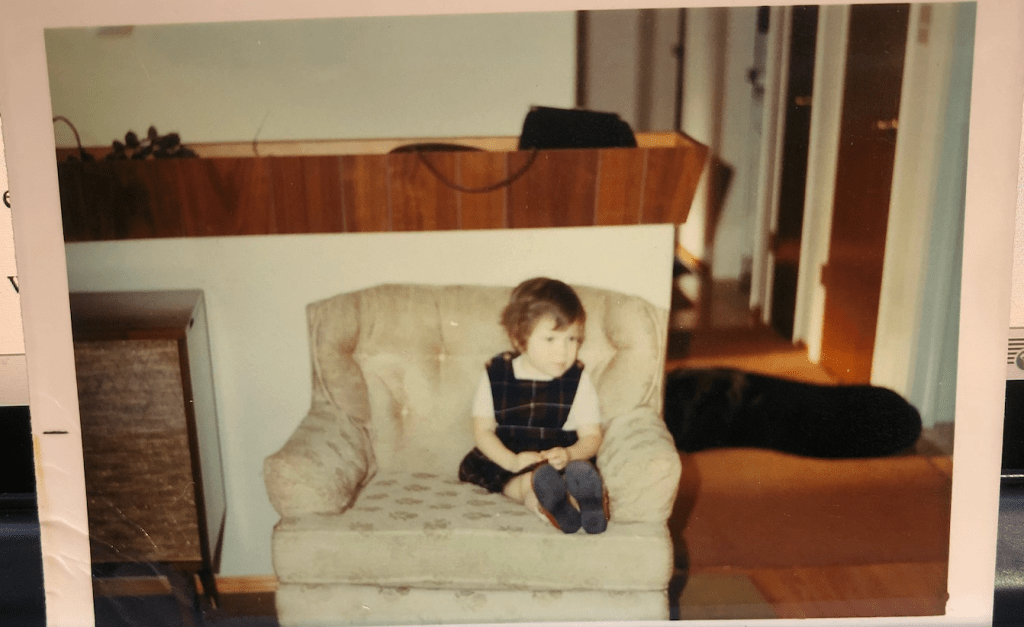
Scene 1. A 1971 kitchen with avocado green appliances, burnt orange wallpaper decorated with stylized coffee pots, and cuckoo clock mounted on the wall with Swiss milkmaids and birds chiming out the quarter-hour. Enter 3-year old MARIE holding a glass baby bottle and SAM, the dog. SAM’S tail knocks the bottle from MARIE’S hand. The bottle breaks on the patterned linoleum floor. MARIE’s MOTHER enters with a broom and hurries SAM out of the kitchen.
MOTHER.
Sam broke your bottle. Here’s a cup.
MARIE, refusing the cup.
Go shopping, buy goggle.
MOTHER, sweeping up the glass. Likely reflecting on her newborn baby born a few weeks earlier as she says:
That was the last bottle. Bottles are for babies. You’re a big girl now.
MARIE, exiting the kitchen, repeating the phrase in her head.
Go shopping, buy goggle.
Ch. 5. Act 2. Scene 1: Brownies, god, queen, saints, and fairies
Marie knew that she should have quit Brownies. That was some crazy mixed up shit. But she knew the family rule about not quitting, a rule reinforced each week by the motivational poster she recited to herself on the wall beside the beam at her gymnastics club: Quitters never win. Winners never quit.
The first year had been fun because her best friend was with her. They both signed up again the second year; but her friend quit. One week she was in the circle with her and the next week she wasn’t. Everything was the same, but nothing was the same: a figure was missing. Marie could see herself in her Brownie uniform performing the Brownie rituals happening around her but felt disconnected, as if all were actors with scripts.
BROWN OWL, turning Marie around by the shoulders.
Listen very carefully, see the magic made!
MARIE, as a Tweenie, chants back then looks in the hand mirror.
Twist me and turn me and show me the elf!
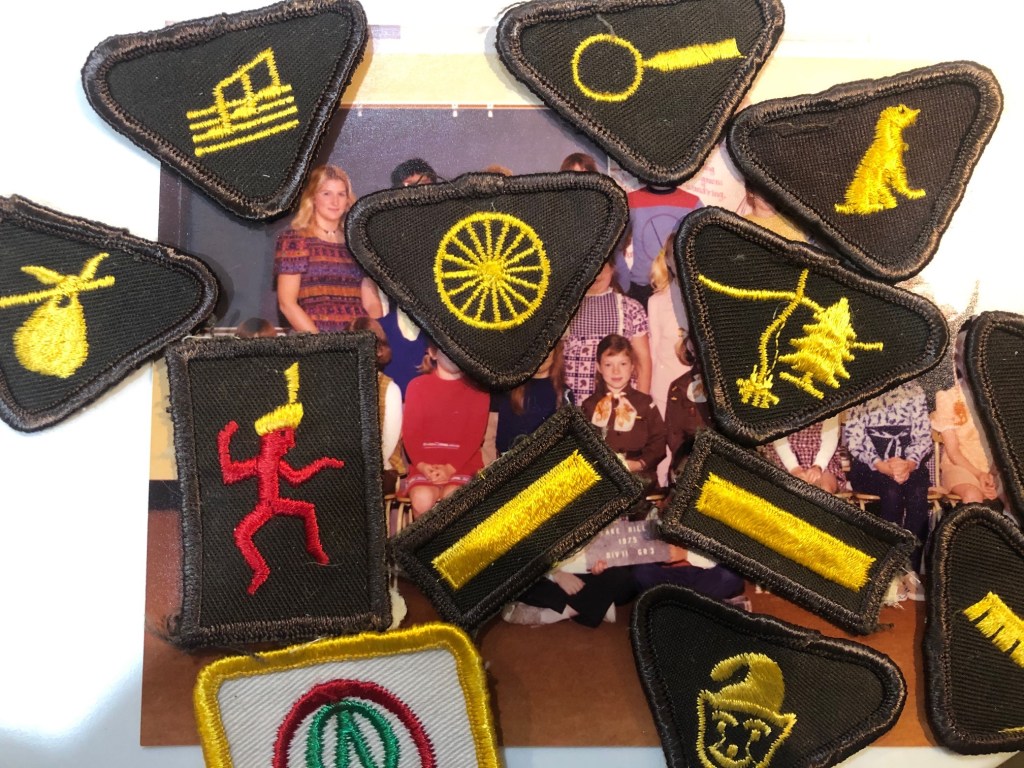
Marie collected badges with the goal to get as many as she could to sew on her dress, layering the brown fabric with brown badges: — “Dear Diary, Today Brown owl is going to give me a certificate to try to get my book lover’s badge. It’s harder to get than you think it is”[1] She dog-eared the Brownie Handbook checking off badge requirements for more badges: pet lover, housekeeper, collector, hostess…
Marie knew the Brownie Promise off by heart, memorizing it from the Handbook then reciting it each week with the pack of girls circling the fairy toadstool after paying their ten-cent dues: “I promise to do my best, to do my duty to God and the Queen, to be someone who thinks of others before herself…” The Brownie routines held in the church’s basement hall were ingrained in her as tightly as the badges her mother sewed onto her dress.
The threads were bound even more securely around duty to God and Queen each morning at school as Marie stood with her classmates (except for the one atheist who stayed sitting, a strange creature to Marie, to be observed but never spoken to) beside their desks in straight lines reciting the Lord’s Prayer and, on occasion, singing “God Save the Queen”.
Downstairs on Wednesdays in her Brownie uniform and upstairs on Sundays in her church clothes reciting the Lord’s Prayer and performing other rituals that also involved paying weekly dues and chanting prayers to mythical creatures such as angels and saints with tales of talking serpents, human sacrifices, and magical occurrences that would rival Lewis Carroll’s “Jabberwackiness” in the Alice in Wonderland series.
Brownies seemed to be built on a foundation of fairies in a woodland setting. The adult female leaders were owls: Brown Owl was the head owl supported by Tawny Owl (Marie’s favourite), Grey Owl, and sometimes there was a Barn Owl. The girls were separated into sixes (six per group) and named after different types of fairies. Marie chanted the Kelpie group song along with the other girls “We’re the little Scottish Kelpies, smart and quick and ready helpers”.
Marie wore her Brownie uniform to school on Wednesdays as she wouldn’t have time to go home and get changed first. The dress had a brown belt to which was clipped a coin purse, oversized for the one dime it carried, and a mini “golf” pencil that seemed decorative rather than practical. Her contemporaries of that era, the boy scouts, carried pocketknives on their belts. A school journal entry from one of those Wednesdays reads: “Dear Diary, Today the class are having the year picture taken. Lisa and I Have to have pictures in our uniform.” The teacher’s comment read, “Don’t you like wearing your uniform? I think it looks sharp!” “No”, Marie thought, “I don’t like going to Brownies”.
Ch. 5. 2. Scene 2: Sick of brownies
Scene 2. A grade three classroom in 1975. Eight-year old MARIE is sitting at her desk.
MARIE looks up at the classroom wall clock, 9:00. Six hours until the end of the school day signaling time to walk to Brownies. She is visibly tightening up and taking short breaths, then suddenly takes one deep breath and her shoulders drop as she jaggedly exhales.
MARIE goes about her morning school routines, writing in her diary, doing math sheets, playing tether-ball at recess, back inside for music then art class, eating lunch out of her Snoopy lunch box, racing outside to the “rock” on the field to join her friends in the club, now hanging up her coat in the cloakroom.
MARIE, approaches the teacher’s desk as the other students take their seats.
I feel sick.
TEACHER.
Oh dear, whatever is wrong?
MARIE.
My tummy hurts.
TEACHER.
Oh my, do you want to lie down in the sick room?
MARIE.
No, I want to go home.
TEACHER.
I will phone your mother.
During the morning activities Marie had been thinking about when she’d tell her teacher that she was sick. She began to take little breaths. She enjoyed school so didn’t want to miss any, but knew that if she waited too long she’d have to go to Brownies and the orange scarf around her neck would tighten more. The cost to going home was that she’d miss that week’s Sing-Out[2] that was broadcast into her classroom from 2:30-3:00. Even though she wasn’t a good singer, she did look forward each week to the sing-along, following along with the familiar words and grey drawings in the song booklets, “I love to go a-wandering, along the mountain track, and as I go, I love to sing, my knapsack on my back, val-de-ri, val de ra…” . Marie climbed into the family station wagon, avoiding Sam’s drool as it rolled down the channels on the vinyl backseat, and let out a deep sigh then felt a warm rush envelop her from the inside out.
After a warm-to-her-tummy snack Marie tucked herself into the orange rocking chair in the living room’s sunny spot, balancing her book and cup of tea on her knees so as not to spill on Pussy who was already in the chair. As she rocked back and forth in the sun she realized that because Sing-out was broadcast on the radio that she should be able to find it on the home stereo. She rested until 2:30, then demonstrated enough wellness to be able to switch on the radio and sing along but kept her dancing minimal so as not to appear too well. The entry from her home diary that day reads, “Today at two a clock I has to come home. I couldnt go to Brownies today.” She breathed and danced and sang in the dusty sunlight streaming into the living room.
Scene 2: Analysis of scene 2 suggests a negative image as in photography or the non-dusty part of a shelf does when a knick-knack is moved, calling attention to the shape that was there. An adult Marie reflects as she considers her attempt as a child to control what now may be recognized as a panic attack. She had enough rational thought and agency to take control of her environment by removing herself from the stress before it closed in on her. She recognized the stress but not why it was causing distress. What was the underlying cause?
Marie used to look at her teacher’s report card comment from that year and thought it off the mark, that the teacher didn’t see what was actually going on for Marie, “Marie is a very happy, self-assertive child who has already formed definite likes and dislikes and opinions of the various subjects or things in her environment”. In fact, that is the image she projected to the world and her teacher was on the mark. However, what her teachers and her parents didn’t see was the worry inside of Marie and the effort it took to control her environment when she felt un-ease. As she got older the physical environment became hard to control so turned to controlling herself in parallel energy as the internal worry intensified. It was about to get very dark.
[1] Journal entries and other artifacts are included in their original form; spelling and other errors have not been corrected. My rationale is that the form is as much of the artifact as the words.
[2] In the words of Lloyd Arntzen, the teacher/musician who led Sing-out, “It was a weekly series designed for elementary school teachers who were expected to teach music but did not have any music in them. It was called Sing out (Like the folk music magazine SINGOUT!). The ministry of education financed it and booklets were sent out with all the lyrics to the songs to the schools” (Harrison, 2011).
 Broken Bones, Broken Brain