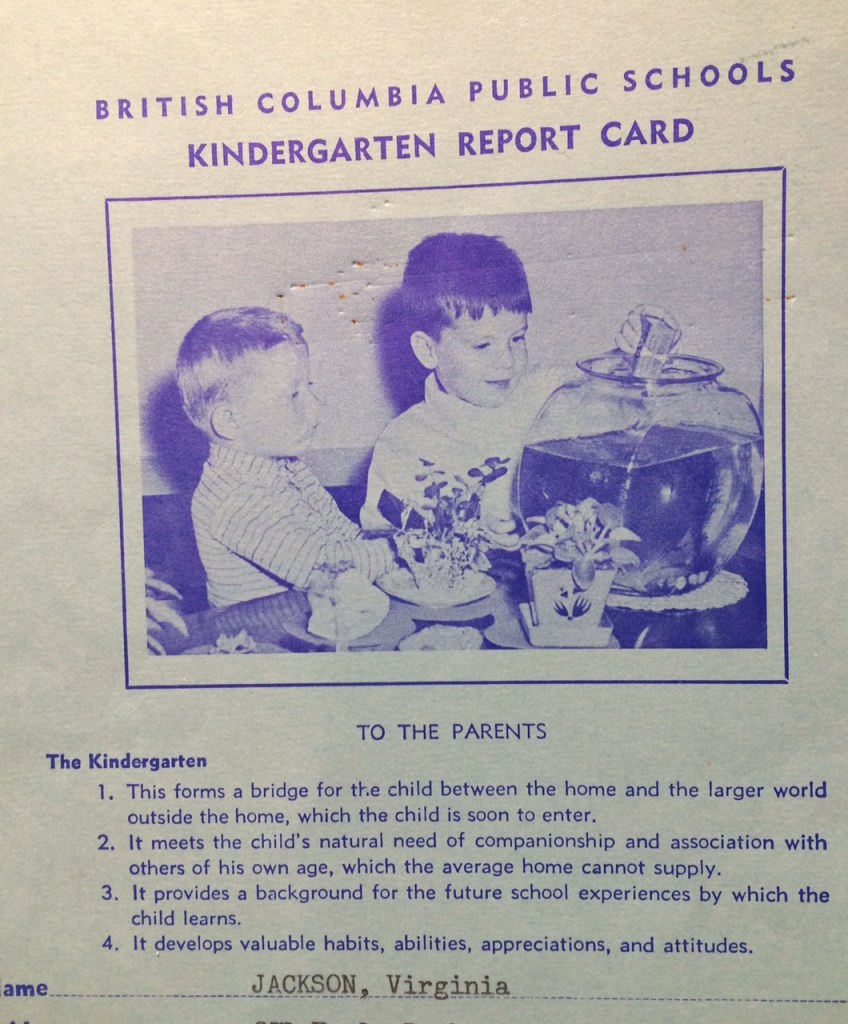
As educators we are asked to know ourselves in order to teach. This story is a lesson long in the making as I looked at my own history. How had my unexamined past impacted students? This lesson’s objective is to illustrate how I re-enacted classroom structures that felt familiar and safe to me but that did not serve some of my students well, that may have served to control rather than educate those for whom I was responsible. What unexamined practices might you have carried into your own classroom?
Attending to policy
Marie was a shiny new K-12 teacher with a few years of elementary classroom experience and now assigned to a school she hadn’t even heard of even though she’d been in the community already for several years by this time. The school was labeled as an alternative education classroom for pregnant and parenting teenagers – the majority of whom were of Indigenous descent – in a small northwestern BC town in the year 2000.
Students are expected to attend school, teachers are expected to take attendance, and schools are expected to track attendance, a commonplace practice—this was the belief Marie had as a student and as a teacher. In the elementary schools where she learned to teach as a student teacher and in which she then practiced as a ‘real’ teacher, attendance was taken first thing in the morning and either that week’s student helper, or a student with an abundance of energy, would ‘run’ the attendance slip to the office. In one school the attendance slip was tucked in the wall pocket secured outside the classroom door; then someone from the office collected the slips. The rationale was twofold: track attendance, as presumably regular attendance was a contributor to student success, and support safety, since the office would follow up on missing students to make sure they were safe.
Marie carried out, with duty but without thought, the practice of attendance taking from her elementary classrooms into the alternative school for pregnant and parenting teens. In this school there was Marie and aa rehabilitation worker whose main responsibility was taking and tracking student attendance, and then phoning students in the morning when they didn’t show up. She did a lot of phoning. She was also supposed to pick them up if they needed a ride, but she chose not to do that, citing something about wanting to teach the students personal responsibility. One of the school’s oft-repeated reasons for wanting students to come to school on a regular basis was to demonstrate readiness to transition to the ‘regular’ high school across the parking lot for their senior years and eventual graduation. The school board office likely also wanted attendance for the purposes of funding a relatively expensive program.
One day Marie was walking with one of her students, Michelle, from the little standalone classroom across the parking lot to the main high school. As they walked Michelle underwent a postural transformation, almost as if she was retreating into herself, slouching, starting to mumble. Marie didn’t say anything but strode with more purpose, perhaps trying to envelope Michelle with confidence as surely this was in the best interests of this student, getting used to being in the main high school. She would never know though as she never asked, just assumed.
Attending to humans: A tale of two funerals
Marie’s friend had a death in her family. She took time allowed as per the workplace collective agreement to attend the funeral: it was during non-instructional time so she didn’t need a substitute teacher making it convenient to take the half-day for the funeral followed by a brief visit with fellow mourners. Marie was back at the school after lunch.
That same year one of Marie’s students, Stephanie, had a relative pass away in her home territory, a fair distance out of town. Stephanie’s attendance at the funeral would be a two-week affair. Marie couldn’t understand why Stephanie needed so much time away. She was concerned as this was a student whom could least afford the time away from school, especially as she already had a poor attendance record, and was not, in Marie’s view, a strong or ambitious student, and this time away would jeopardize her ability to graduate, assuming that of course Stephanie wanted to graduate. Marie however kept all these thoughts to herself and wished Stephanie well over the next two weeks; Marie directed the rehabilitation worker to mark Stephanie as an excused long-term absence for the school board’s records.
Re-Examining Attendance: My lesson
I thought, accepted, that the commonplace practices of school provided the path that was in the best interests of students, therefore I reproduced practices such as enforcing attendance. I could not understand then that there were other paths, and timelines, in school, and life, than what I had internalized through my own school years, teacher training, and teacher practice. I did not ask my students what their paths were for themselves, nor did I ask why I was implementing practices in such a ‘wholesale,’ systematic, and now, I realize, unexamined manner.
It wasn’t until I read a passage out of They Called Me Number One (2013), a memoir by Bev Sellars about her years in an Indian residential school, that I began to articulate words around the question of whether Stephanie’s attendance at the funeral may have served her interests better than attendance at school, and that as her teacher I didn’t understand nor have compassion in this regard. Here is Sellars account of when her grandmother’s mother died and the husband’s attempt to pull his two daughters out of school for the funeral:
Gram’s dad, John, went to the Mission to get them but was told he would not be able to take his girls home for the funeral. He would not give up, and finally he was allowed to take Gram and Annie to their mother’s funeral. Gram says that lots of Marguerite’s people paddled downriver from Quesnel for the funeral. Gram says that many, many canoes lined the banks of the river that day. (p. 7)
Upon reading this passage I thought of Stephanie’s need to go home for the funeral and had the realization that my attitude was not far removed from those at the school in Mission. Upon further reflection, I recognize that I was replicating colonial thinking that informed much of my practice as a teacher: thinking internalized and reinforced both as a K-12 student and as an education student in the latter half of the 20th century.
If I were a teacher at the alternative school today, how would I meet the requirements and policies of my school, such as taking attendance, while meeting the “best interests” of my students? A hypothetical question, but one that now I ask. Another question that I can ask is how did this teacher become who she was? Once out of Plato’s cave, she cannot retreat.
-Sellars, B. (2013). They called me number one. Vancouver, BC: Talonbooks.
 Broken Bones, Broken Brain